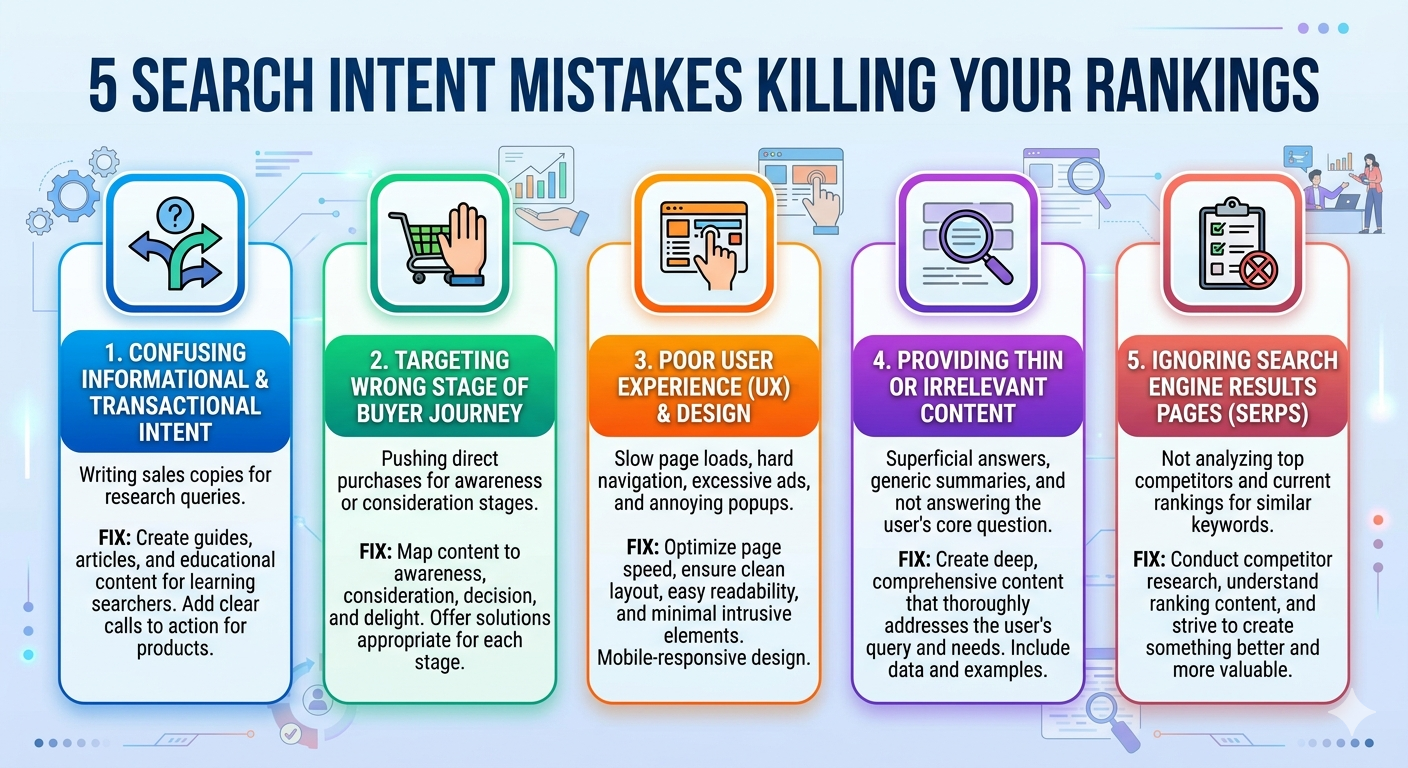
5 Search Intent SEO Mistakes Killing Your Rankings (2026 Guide)
Creating well-optimized content does not always lead to better rankings. One common reason is a mismatch between your content and what people expect when they search.
You may target the right keyword but still struggle if you choose the wrong intent, content format, or approach.
In this guide, you’ll learn 5 common search intent SEO mistakes and simple ways to fix them before they affect your content performance.
What Is Search Intent in SEO?
Search intent is the reason behind a user’s search query. It helps you understand whether someone wants to learn, compare options, find a specific website, or take an action.
For example:
- “What is SEO?” → Informational
- “Best SEO tools” → Commercial
- “Ahrefs login” → Navigational
- “Buy SEO software” → Transactional
Before creating content, understanding the search intent behind the keyword helps you choose the right topic, format, and level of detail.
If you need a deeper explanation of the different intent types, you can see Types of Search Intent Explained cluster here.
5 Search Intent SEO Mistakes
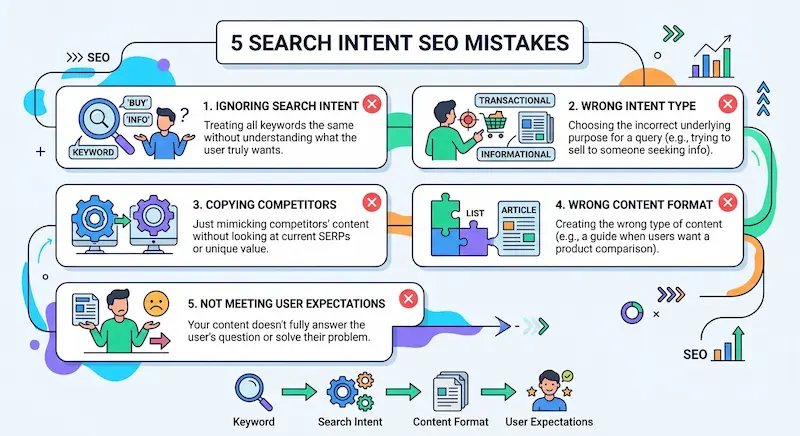
Mistake #1: Ignoring Search Intent
One of the most common search intent SEO mistakes is creating content without first understanding what the searcher wants.
You may have the right keyword and well-written information, but the page can still struggle if it answers a different need.
Example:
If someone searches “best SEO tools,” they are likely comparing options. A basic article explaining what SEO tools are may not match that expectation.
How to Fix It
Before writing:
- Search the keyword on Google.
- Review the top-ranking pages.
- Identify the dominant intent.
- Check what type of content is ranking.
- Create content that directly addresses that need.
This simple check can prevent a major search intent mismatch before you publish.
Mistake #2: Targeting the Wrong Intent Type
Another common search intent SEO mistake is choosing a content type that does not match the user’s goal.
For example, a person searching “best SEO tools” is likely comparing options. A general educational article may not satisfy that need as well as a comparison-style page.
How to Fix It
Match the keyword to the likely intent:
| Search Query | Intent | Suitable Format |
|---|---|---|
| “What is SEO?” | Informational | Guide |
| “Best SEO tools” | Commercial | Comparison/list |
| “Ahrefs login” | Navigational | Website/login page |
| “Buy SEO software” | Transactional | Product/landing page |
Before publishing, check whether your content format, structure, and depth match what the searcher is trying to accomplish.
Mistake #3: Copying Competitors Blindly
Looking at competing pages can help you understand the SERP, but copying their content or structure does not make your article more useful.
Common mistakes include:
- Rewriting competitor content
- Copying their headings
- Focusing only on word count
- Ignoring content gaps
- Adding no original value
How to Fix It
Use competing pages for research, not copying.
Look for:
- Questions they answer poorly
- Missing examples
- Outdated information
- Topics that need clearer explanations
For broader guidance on creating helpful, reliable content, see Google Search Central’s guidance on creating helpful content
Then create content that addresses those gaps and provides something genuinely useful to the reader.
You can also combine search intent tools with manual SERP analysis to understand the ranking patterns before creating your own content.
Mistake #4: Ignoring Content Format
Users often expect a specific type of content for a particular search. If your format does not match that expectation, even useful information may fail to satisfy the query.
For example:
- “How to…” → Step-by-step guide
- “Best…” → List or comparison
- “Vs” → Comparison
- “Review” → Detailed review
- “Pricing” → Pricing or product page
How to Fix It
Check the top-ranking results before writing and identify the format that appears most often. Then choose a format that matches the dominant search intent instead of forcing every keyword into a standard blog-post structure.
Mistake #5: Not Meeting User Expectations
Even when the topic and format are correct, the content can still miss the searcher’s expectations.
Readers usually want content that is:
- Easy to scan
- Clear and direct
- Well-structured
- Helpful and relevant
- Supported by useful examples
How to Fix It
Make the main answer easy to find. Use clear headings, short paragraphs, bullet points, and examples where they genuinely help.
Before publishing, ask:
Does this page give the searcher what they expected from this query?
If the answer is no, improve the content before focusing on additional keyword optimization.
How to Fix Search Intent SEO Mistakes
Fixing search intent problems starts with comparing your content against the current Google results. Instead of guessing, use a simple process to find where your page does not match the searcher’s needs.
Step 1: Analyze the SERP
Search your target keyword on Google and review the top-ranking pages.
Look for:
- Content type
- Common headings and topics
- Level of detail
- Features appearing in the SERP
Step 2: Confirm the Search Intent
Ask what the searcher is trying to accomplish:
- Learn something?
- Compare options?
- Find a specific page?
- Take an action?
Step 3: Match the Content Format
Choose a format that fits the intent.
For example:
- “How to” → Step-by-step guide
- “Best tools” → List or comparison
- “Review” → Detailed review
Step 4: Improve the Content
Instead of simply copying competing pages, improve your article with clearer explanations, useful examples, actionable information, or updated details.
Step 5: Review User Experience
Make the page easy to scan with clear headings, short paragraphs, and direct answers.
How to Audit a Page for Search Intent Mistakes
Before rewriting an underperforming page, check whether it actually matches the searcher’s goal.
Ask these questions:
- Does the content answer the main query?
- Does the content format match the current SERP?
- Does the introduction address the user’s need quickly?
- Are the important topics covered clearly?
- Is there unnecessary information that distracts from the main purpose?
- Does the page provide useful value instead of simply copying competing content?
If several answers are “no,” your page may have a search intent mismatch that needs to be fixed.
For a broader understanding of how search intent works and how to match content with user needs, see our Search Intent SEO Guide.
Signs Your Content Has a Search Intent Problem
Sometimes the problem is not obvious. Look for these signs when reviewing an underperforming page:
- The page ranks for keywords that are different from its main topic.
- Google shows a different content format for the target query.
- Visitors may not find the answer they expected from the title.
- The article covers the topic but does not address the main purpose of the search.
- Your page attracts impressions but gets few relevant clicks.
- The content needs major changes to match the pages currently appearing in the SERP.
These signs do not automatically mean search intent is the problem. Use them as signals to review the keyword, SERP, and content together.
FAQ About Search Intent SEO Mistakes
Can content rank without matching search intent?
It can be difficult for content to perform well when it does not satisfy the searcher’s goal. A well-optimized page can still struggle if its topic or format does not match the query.
How do I fix content with the wrong search intent?
Start by reviewing the keyword and current Google results. Then adjust the content’s intent, format, structure, and user experience to better match what searchers expect.
How do I identify search intent before writing?
Search the target keyword and study the top-ranking pages. Look for common content types, topics, formats, and questions to understand what users are expecting.
Conclusion
Avoiding search intent SEO mistakes starts with understanding what the searcher wants before creating or updating a page.
Check the keyword, analyze the Google SERP, choose the right content format, and make sure your page clearly satisfies the user’s goal.
If an existing article is not performing well, review its intent, format, structure, and relevance before making more keyword changes.
For a deeper step-by-step process, see How to Identify Search Intent for Keywords.

About the Author
Khushbakht Aaliya
Khushbakht Aaliya is an SEO content writer and the founder of The Calm Quill Writes. She creates practical, beginner-friendly guides on SEO writing, keyword research, search intent, and content strategy.
Through The Calm Quill, she shares simple explanations and actionable techniques to help beginners create useful, well-structured content for readers and search engines.