Why Search Intent Matters for SEO
You can create a detailed, well-researched article and still struggle to rank if it does not match what people are looking for.
Search intent SEO is the reason behind a search query—the information, answer, comparison, or action a person expects to find.
For SEO writers and beginner bloggers, understanding search intent helps answer an important question:
What type of content does this searcher actually need?
For example:
- “what is SEO writing” → wants to learn
- “best SEO writing tools” → wants to compare options
- “SEO writing service” → may be looking for a service
Google Search results can also provide clues about the dominant intent behind a keyword.
In this guide, you’ll learn:
- what search intent means in SEO
- the four main types of search intent
- how search intent affects keyword and content planning
- how to match content with the searcher’s goal
📌 What Is Search Intent in SEO?
Search intent in SEO is the purpose behind a user’s search query—the goal they want to achieve when they search on Google.
In simple terms, it is the “why” behind a keyword.
For example:
- “what is SEO writing” → learn about a topic → informational intent
- “best SEO writing tools” → compare options → commercial intent
- “SEO writing service” → find or hire a service → transactional intent
Understanding the searcher’s goal helps you choose a suitable topic, content format, and level of detail instead of focusing on keywords alone.
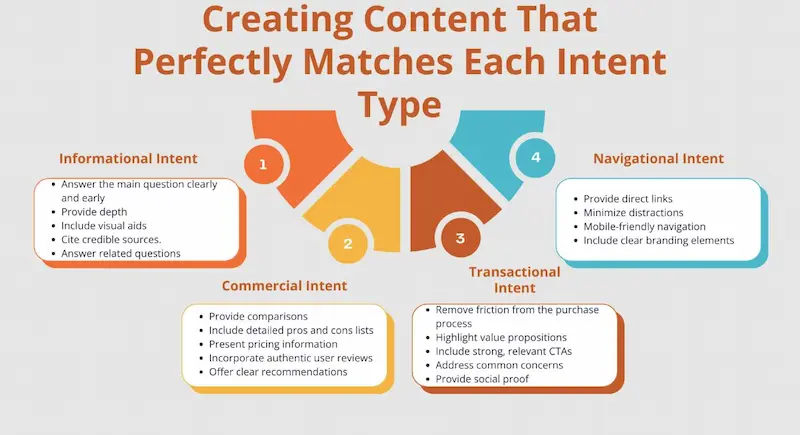
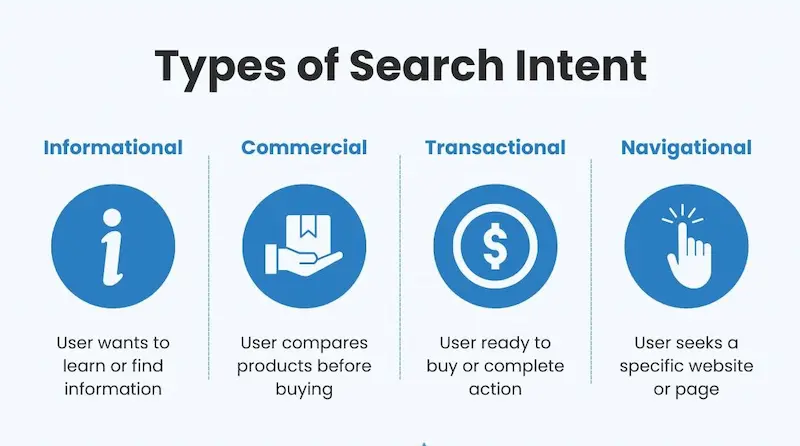
🔍 4 Types of Search Intent
Most SEO queries fall into four common categories:
| Search intent | What the user wants | Example |
|---|---|---|
| Informational | Learn something or find an answer | “what is SEO writing” |
| Navigational | Find a specific website or page | “Google Search Console” |
| Commercial | Compare options before deciding | “best SEO writing tools” |
| Transactional | Take an action or complete a task | “buy SEO software” |
The same keyword can sometimes have mixed intent, but one intent is usually more dominant in the search results.
For detailed examples, content formats, and differences between these categories, see Types of Search Intent Explained.
How to Identify Search Intent for a Keyword
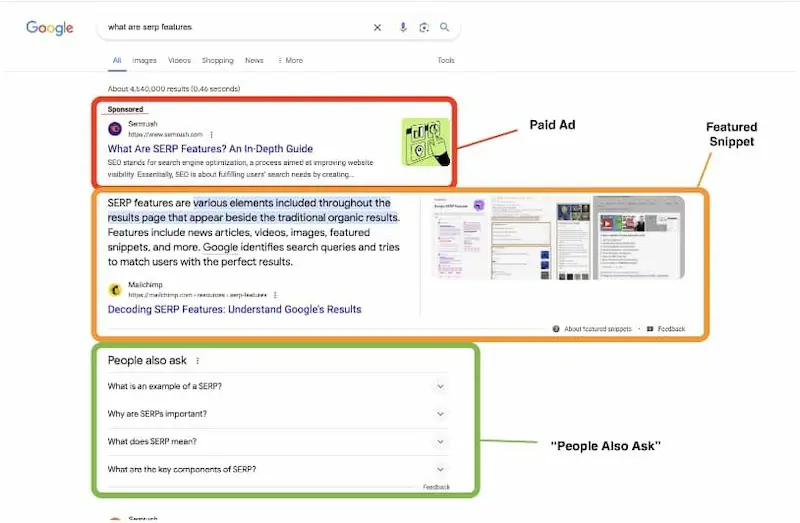
You can get a quick idea of keyword search intent by looking at two things: the wording of the query and the Google results for it.
For example, a keyword such as “how to write an SEO blog post” suggests an informational, how-to intent. Checking the SERP can then confirm whether Google mainly shows tutorials, guides, or other content formats.
This gives you a simple framework:
Keyword → SERP → User Goal → Content Format
For the complete step-by-step process, see How to Identify Search Intent for Keywords.
Now that you understand how to identify search intent, let’s look at how to analyze it using real search results.
👇
🔬 Search Intent Analysis: Match the User’s Goal
Search intent analysis means examining a keyword and its search results to understand what the searcher expects to find.
Before creating content, consider:
- What is the searcher’s main goal?
- What type of pages appear in Google?
- Which content format is most common?
- Does your planned page satisfy that need?
This helps you choose a relevant content type, format, and angle instead of creating an article based on the keyword alone.
For the full analysis process, see How to Identify Search Intent for Keywords.
How Search Intent Fits Into Keyword Research
Search intent should be considered before choosing a keyword, not after writing the content.
When evaluating a keyword, ask:
- What does the searcher want to accomplish?
- Is the query informational, navigational, commercial, or transactional?
- What type of pages are already ranking?
- Does the keyword match your topic and audience?
For example, “how to write SEO content” has a learning-focused intent, so a practical guide is more appropriate than a service page.
Considering search intent during keyword research helps you select topics that fit both the searcher’s needs and your SEO content strategy.
For the complete keyword research process, see Keyword Research for SEO Writing.
⚙️ How to Match Content With Search Intent
Once you understand the intent behind a keyword, your content should satisfy the searcher’s main goal. A strong search intent SEO strategy focuses on matching the user’s goal with the right content format, topic depth, and page structure.
This means choosing a suitable:
- Content format — guide, comparison, list, service page, etc.
- Topic depth — enough detail to answer the query properly
- Content angle — the approach that best fits the searcher’s needs
- Page structure — headings and sections that make the answer easy to find
For example, if people searching for “how to find long-tail keywords” mainly want a practical process, a step-by-step guide is more appropriate than a short definition.
The goal is not to repeat a keyword throughout the page. It’s to create relevant, useful content that matches the query and its intent.
For the complete optimization process, see How to Optimize Content for Search Intent.
For more guidance on creating useful, people-first content, see Google Search Central’s helpful content guidance
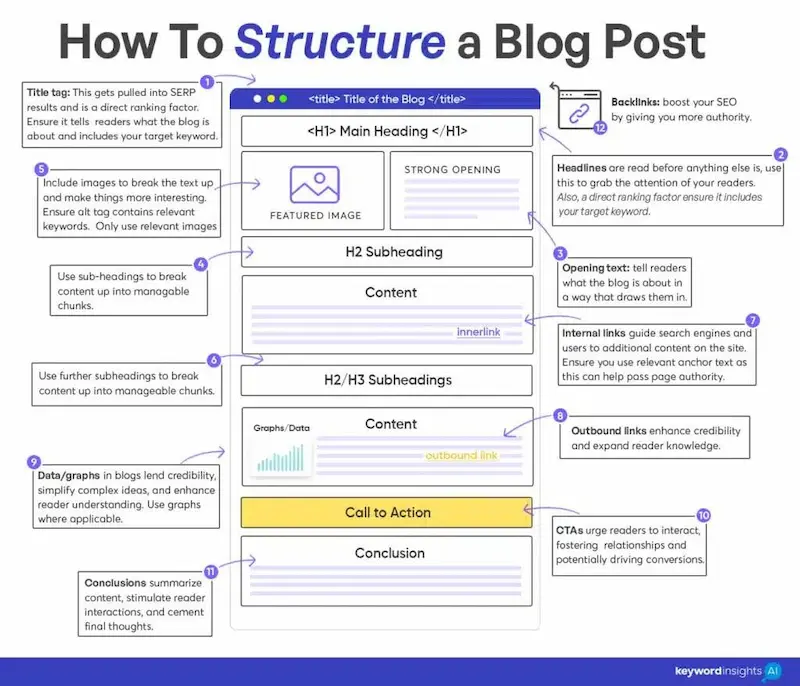
A Simple Search Intent SEO Framework
If you’re new to search intent SEO, use this simple four-step framework before creating a page:
1. Keyword → What does the search query say?
2. SERP → What type of pages are ranking?
3. User Goal → What is the searcher trying to learn, find, compare, or do?
4. Content Match → Can your page satisfy that goal better and more clearly?
Example
For the keyword “how to find long-tail keywords”:
Keyword: how to find long-tail keywords
SERP: guides and tutorials
User goal: learn the process
Content match: a practical step-by-step guide
This framework helps SEO writers move from keyword selection to search-intent-focused content without relying on keyword placement alone.
For the detailed identification process, see How to Identify Search Intent for Keywords.
Search Intent Examples for SEO Content
Seeing search intent in real keywords makes the concept easier to understand.
| Search query | Likely intent | Suitable content |
|---|---|---|
| what is SEO writing | Informational | Beginner guide |
| how to write an SEO blog post | Informational | Step-by-step tutorial |
| best SEO writing tools | Commercial | Comparison/list |
| SEO writing service | Transactional | Service page |
| Google Search Console login | Navigational | Official website/page |
For SEO writers, the important question is not simply “What keyword should I target?” but “What does someone expect to find after searching this keyword?”
That expectation should guide the content format, topic depth, and page type you create.
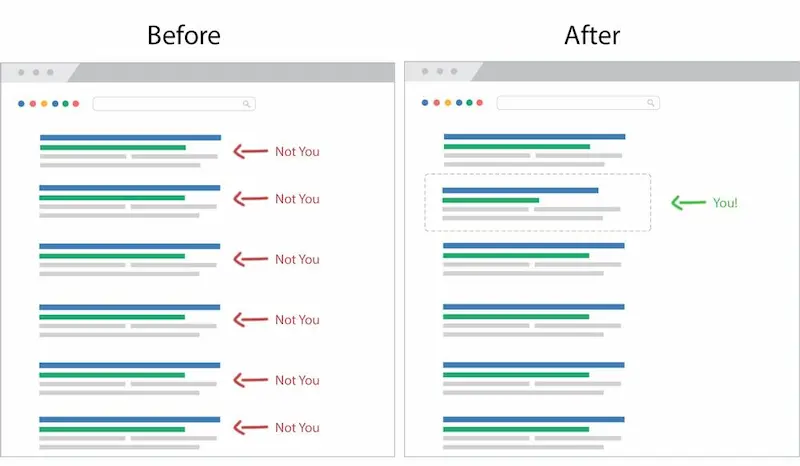
Why Search Intent Matters for SEO
Understanding search intent helps you create content that is relevant to the query and useful to the person searching. Understanding search intent SEO helps you create content that matches what people actually expect from a search query.
It can help you:
- choose a suitable content format
- avoid targeting the wrong search intent
- create content that answers the searcher’s main question
- improve your SEO content strategy
- make better decisions during keyword research
For example, a keyword with informational intent usually calls for educational content, while a commercial query may require comparisons, reviews, or other decision-support content.
The key is to make the content and searcher’s goal align, rather than optimizing a page around a keyword alone.
Common Search Intent SEO Mistakes
Avoid these common mistakes when creating SEO content:
- Ignoring the SERP — not checking what type of pages rank.
- Choosing the wrong intent — targeting a different goal from what searchers expect.
- Using the wrong format — creating a guide when the query needs a comparison, service page, or tutorial.
- Focusing only on keywords — optimizing phrases without solving the searcher’s problem.
- Copying existing content — following competitors without adding useful, original value.
For detailed examples and solutions, see Search Intent SEO Mistakes.
Search Intent vs. Keywords
A keyword is the phrase someone types into Google, while search intent is the goal behind that search.
For example:
- Keyword: “how to write an SEO blog post”
- Search intent: Learn how to complete the task
- Suitable content: Step-by-step guide
Another example:
- Keyword: “best SEO writing tools”
- Search intent: Compare available options
- Suitable content: Comparison or list
Understanding both keywords and search intent helps you choose topics and create content that better matches what searchers expect.
Conclusion
Search intent SEO helps you move beyond targeting keywords and focus on what people actually want from a search. Search intent SEO helps you move beyond targeting keywords and focus on what people actually want from a search.
Before creating content, use this simple process:
Keyword → SERP → User Goal → Content Match
Then choose a content format and level of detail that genuinely fits the query.
If you want to go deeper, explore:
- Types of Search Intent Explained
- How to Identify Search Intent for Keywords
- How to Optimize Content for Search Intent.
FAQ: Search Intent SEO
What is search intent in SEO?
Search intent in SEO is the goal behind a user’s search query. It helps you understand whether someone wants to learn, find something, compare options, or take an action.
How do I find the search intent of a keyword?
Search the keyword on Google and examine the top-ranking pages, content formats, and topics. These SERP patterns can reveal what users expect to find.
For the complete process, see How to Identify Search Intent for Keywords.
How do I match content with search intent?
First identify the searcher’s goal, then choose a suitable content format, topic angle, and level of detail. Your page should directly satisfy what the searcher expects from the query.
For the detailed optimization process, see How to Optimize Content for Search Intent.

About the Author
Khushbakht Aaliya
Khushbakht Aaliya is an SEO content writer and the founder of The Calm Quill Writes. She creates practical, beginner-friendly guides on SEO writing, keyword research, search intent, and content strategy.
Through The Calm Quill, she shares simple explanations and actionable techniques to help beginners create useful, well-structured content for readers and search engines.