🚀 How Beginners Can Actually Rank Competitive Keywords
Let’s be honest.
Ranking for competitive keywords as a beginner feels impossible.
You search a keyword…
And all you see are:
- Big brands
- High-authority websites
- Pages with thousands of backlinks
So naturally, you think:
“I can’t compete with this.”
And most SEO guides make it worse.
They tell you:
- “Just target low competition keywords”
- “Avoid competitive niches”
- “Wait until your authority grows”
But here’s the problem…
❌ No one explains how you eventually move from low competition → competitive keywords.
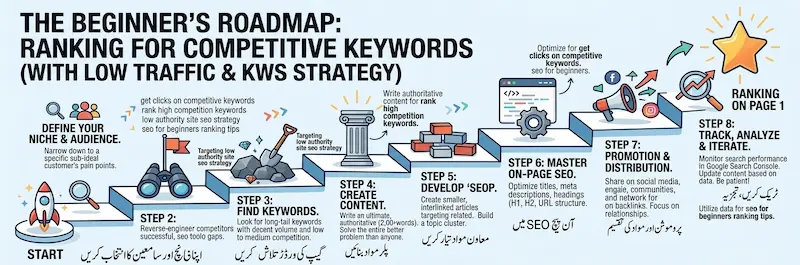
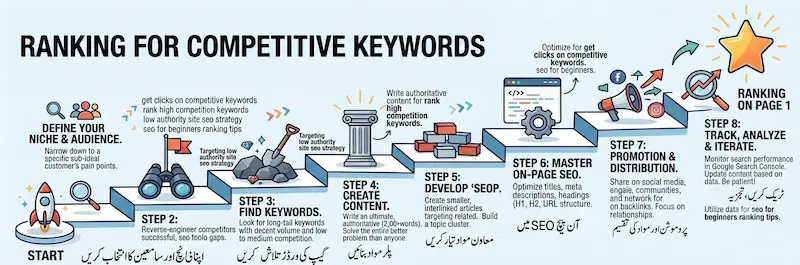
If you’re trying to rank for competitive keywords as a beginner, this guide gives you a realistic, step-by-step roadmap.
😓 My Blog Is Not Ranking — What’s Going Wrong?
If you’re feeling like:
❝ My blog is not ranking no matter how much content I publish ❞
You’re not alone.
Most beginners face this because:
- They target keywords that are too competitive too early
- They don’t have backlinks or authority
- Their content lacks strategic structure
Here’s the truth:
👉 It’s not that your blog can’t rank
👉 It’s that your strategy is not aligned yet
💡 Reality Check:
You don’t start by trying to rank competitive keywords directly.
You build your way up to them.
That’s exactly what this guide will help you do.
🎯 What This Article Will Actually Help You Do
This is not another theory-based SEO guide.
This is a practical roadmap for beginners who want to:
- Compete with high-authority sites
- Rank strategically (not randomly)
- Build authority step-by-step
- Eventually target competitive keywords with confidence
🧠 What Does “Low Authority” Mean?
Low authority websites are sites with few backlinks, limited content, and low trust signals. These are usually new domains (0–6 months old) that can still rank using focused SEO strategies.
Key Characteristics
- Few or zero backlinks
- New domain (0–6 months)
- Limited content
- Low trust signals
⚡ Important Insight:
Google ranks pages, not entire websites.💡 According to Google, ranking is not just about authority but also relevance and usefulness of content. You can learn more about how search works directly from Google here:
👉 https://developers.google.com/search/docs/fundamentals/how-search-works
⚔️ Low Authority vs High Authority Websites
| Factor | Low Authority Website | High Authority Website |
|---|---|---|
| Backlinks | Few | Many |
| Trust Level | Low | High |
| Ranking Speed | Slow initially | Faster |
| Competition Power | Limited | Strong |
| Flexibility | High | Moderate |
💡 Expert Insight:
Low authority sites win by focus and speed, not power.
💡 The Real Problem Beginners Face
Most beginners struggle because:
- Competitive keywords feel out of reach
- There’s no clear growth path
- SEO advice is too generic
🔥 Big Truth:
You can rank competitive keywords as a beginner…
But not directly—you need a smart progression strategy.
😵 Confusion Between Low vs High Competition Keywords
One of the biggest mistakes beginners make:
👉 Not understanding which keywords to target first
This creates confusion like:
- “Should I go for easy keywords or competitive keywords?”
- “When should I target high competition keywords?”
- “Why is my content not ranking even after indexing?”

Here’s the simple clarity:
| Keyword Type | When to Use | Goal |
|---|---|---|
| Low Competition | Starting phase | Get traffic + build trust |
| Medium Competition | Growth phase | Build authority |
| Competitive Keywords | Later stage | Scale traffic |
💡 Key Insight:
You don’t avoid competitive keywords forever…
👉 You prepare your site to rank competitive keywords
That’s the difference between random blogging and strategic SEO.
🎯 Why This Guide Is Different
Most SEO articles tell you what to do.
This one shows you:
✅ How to go from zero authority → ranking competitive keywords step by step
No fluff.
No outdated advice.
Just strategies that actually work in real scenarios.
👉 Now let’s break down the exact system.
📉 Content Gets Indexed But No Clicks — Why?
This is one of the most frustrating problems:
👉 Your content is indexed on Google
👉 But you get zero clicks
Why this happens:
- Wrong keyword targeting
- Weak titles and meta descriptions
- Competing directly with high-authority sites
- No clear search intent match
❝ You’re visible… but not attractive to click ❞
If your blog is not ranking, the problem is usually not effort — it’s strategy to rank competitive keywords.”One major reason your content gets indexed but no clicks is weak titles. If your headline isn’t compelling, users won’t click—even if you rank.
👉 Improve CTR with these proven SEO title writing tips:

🔍 How This Connects to Ranking Competitive Keywords
If you try to rank competitive keywords too early:
- You get buried in search results
- Your CTR (click-through rate) stays low
- Google sees low engagement → rankings drop further
👉 That’s why strategy matters more than effort.
💡 Fix:
Start with easier wins → build authority → then target competitive keywords
And that’s exactly what the next section will show you.
🔥 7 Powerful Ways to Rank Competitive Keywords With Low Authority
1. 🎯 Start With Easier Keywords Before Targeting Competitive Terms
New websites usually shouldn’t begin by targeting the most competitive keywords in their niche. Starting with easier opportunities allows you to publish relevant content, build topical coverage, and learn which topics your audience responds to before moving toward harder keywords.
Before trying to rank competitive keywords, make sure you understand the fundamentals of SEO writing:
👉 https://thecalmquillwrites.com/seo-writing-for-beginners/
Example
- ❌ SEO tips
- ✅ SEO writing tips for beginners
Why It Works
- Easier to rank
- Better conversions
- Faster results
💡 Real Insight: I ranked a new blog in 3 weeks using this method—no backlinks.
💡 If you’re just starting, understanding how to structure content properly is critical.
If you’re still building your keyword strategy, start by learning how to find low-competition keywords that are more realistic for a newer website.
2. 🧩 Use Bridge Content Strategy
Bridge content = stepping stones to bigger keywords
Example Flow
- SEO basics
- SEO mistakes
- SEO checklist
💡 Helps Google understand your niche gradually
3. 🧱 Build Topical Authority
Cover one topic deeply.
Example Cluster
- SEO tips
- SEO mistakes
- SEO titles
- Keyword research
📈 Sites with 10–15 related posts often see compounding growth
4. 🔗 Use Internal Linking
Internal links = free SEO boost
Best Practices
- Link related posts
- Use keyword anchors
- Link to pillar content
💡 One site saw +40% impressions just from internal linking
5. 🔍 Target Weak SERPs
Look for bad content ranking on Google.
Signs of Weak SERPs
- Outdated content
- No headings
- Poor structure
- No examples
🎯 Opportunity = Easy rankings
6. 🧠 Use Keyword Layering
Use multiple keyword types:
- Primary keyword
- Secondary keywords
- Semantic (NLP) keywords
💡 This helps rank for multiple keywords from one article
Understanding search intent is critical if you want to rank competitive keywords effectively. This guide explains how Google interprets intent and ranks content accordingly:
👉 https://moz.com/learn/seo/search-intent
7. 📅 Stay Consistent + Focus on Intent
Consistency builds trust.
Simple Plan
- Week 1 → Basics
- Week 2 → Keywords
- Week 3 → Content
- Week 4 → Strategy
⏳ Expect results in 30–90 days
⚠️ Mistakes to Avoid
🚫 Avoid these common SEO killers:
- Targeting high competition keywords
- Ignoring internal links
- Writing generic content
- Missing search intent
- No strategy
Many beginners unknowingly repeat the same errors that prevent them from ranking competitive keywords.
👉 Avoid these common SEO mistakes to improve your results faster:
https://thecalmquillwrites.com/seo-mistakes-to-avoid/
📊 Quick Summary
📌 Ranking Checklist
- Use long-tail keywords
- Build topical authority
- Add internal links
- Target weak SERPs
- Use keyword layering
- Stay consistent
- Focus on intent
🧪 Real Example
A beginner published:
- SEO writing tips
- SEO mistakes
- SEO titles
- Keyword research
- Content writing
📈 Result
- Ranked in 60 days
- Gained traffic
- Built authority
💡 Success came from strategy—not backlinks
⚖️ Pros and Cons
| Pros | Cons |
|---|---|
| Easy to start | Slow trust building |
| Flexible | Hard for big keywords |
| Fast niche growth | Needs consistency |
🔍 Smart SEO vs Traditional SEO
| Strategy | Traditional SEO | Smart SEO |
|---|---|---|
| Focus | Backlinks | Content + intent |
| Keywords | Competitive | Long-tail |
| Approach | Broad | Focused |
| Results | Slow | Faster |
❓ FAQs (Schema Ready)
What is the fastest way to rank?
Use long-tail keywords + helpful content + internal linking. Results can appear in 30–90 days.
Can I rank without backlinks?
Yes. Many low-competition keywords don’t require backlinks.
How long does it take to rank?
Typically 1–3 months for beginner-friendly keywords.
Best SEO strategy for beginners?
Focus on:
Long-tail keywords
Topical authority
Consistency
🏁 Conclusion
You don’t need a big website.
You don’t need thousands of backlinks.
💡 You need a smart strategy.
Focus on:
- Right keywords
- Helpful content
- Consistency
And rankings will follow.
🚀 CTA (Call-To-Action)
🎯 Start Today:
- Pick 1 long-tail keyword
- Write 1 helpful article
- Repeat weekly
👉 That’s how real SEO growth happens.