
On-Page vs Off-Page SEO for Content Writers: Beginner’s Guide
Writing a useful blog post is only one part of getting organic traffic. Your content also needs to be easy for search engines to understand, relevant to the search query, and supported by signals that build website authority.
That’s where on-page vs. off-page SEO for content writers comes in.
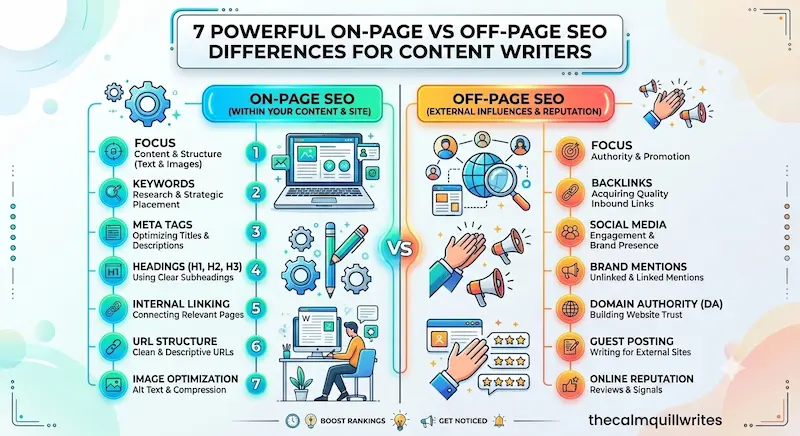
On-page SEO focuses on elements you can control on your website, such as keyword usage, content structure, search intent, internal links, and meta information. Off-page SEO focuses on signals outside your website, especially backlinks, brand mentions, and content promotion.
For content writers, understanding the difference helps you know what to optimize inside an article and what can be improved outside it.
In this guide, you’ll learn:
- What on-page and off-page SEO mean
- The key differences between them
- Which SEO elements content writers can control
- How to optimize a blog post for search
- Practical off-page SEO techniques for writers
- How both approaches work together
What Is On-Page vs Off-Page SEO?
On-page and off-page SEO are two parts of a broader SEO strategy, but they focus on different areas.
A simple way to remember the difference:
- On-page SEO = what you optimize on your website
- Off-page SEO = how your website builds authority outside it
For content writers, this distinction is useful because most of the work involved in creating a search-friendly article happens on the page. Off-page SEO then helps strengthen the website’s visibility and authority over time.
Why Content Writers Need to Understand SEO
Writing well is important, but good writing alone does not guarantee that a blog post will appear prominently in search results.
Content writers need basic SEO knowledge to make their articles easier to understand, navigate, and match with what readers are searching for.
For example, an SEO-friendly article should:
- Match the reader’s search intent
- Use relevant keywords naturally
- Have a clear heading structure
- Provide useful, original information
- Include relevant internal links
- Be easy to read and scan
These elements help turn a well-written article into search-friendly content rather than simply adding keywords to a page.
If you are learning SEO writing from scratch, see the guide on SEO writing for beginners for the broader writing process.
On-Page vs Off-Page seo for content writers
The easiest way to understand the difference is to look at where the SEO work happens and what you can control.
| Factor | On-Page SEO | Off-Page SEO |
|---|---|---|
| Main focus | Content and page elements | External authority signals |
| Where it happens | On your website | Outside your website |
| Level of control | High | Limited |
| Common examples | Keywords, headings, internal links | Backlinks, mentions, promotion |
| Main purpose | Improve relevance and usability | Build authority and trust |
These two SEO approaches work together when you’re trying to rank blog posts on Google.
For content writers, on-page SEO is closely connected to the article itself, while off-page SEO extends beyond the page and involves how other websites and platforms interact with your content.
🔍 What Is On-Page SEO for Content Writers?
On-page SEO is the process of optimizing the content and page elements you can control on your own website.
For content writers, this mainly means making an article relevant, well-structured, readable, and easy for search engines to understand.
Key on-page SEO elements include:
- Keyword optimization — use the primary and related keywords naturally.
- Search intent — make sure the content answers what the searcher actually wants.
- Headings and structure — organize the article with clear H2s and H3s.
- Internal linking — connect the article with relevant pages on your website.
- Readability — use short paragraphs, lists, and clear language.
- Meta elements — write a useful SEO title and meta description.
- Image optimization — use descriptive alt text where appropriate.
The goal isn’t to place a keyword everywhere. It’s to create content that clearly satisfies the topic while making the page easy to navigate.
For Google’s own guidance on creating search-friendly websites and content, see the Google Search SEO Starter Guide.
What Is Off-Page SEO for Content Writers?
Off-page SEO refers to activities outside your website that can help build its authority, credibility, and visibility.
For content writers, the most familiar off-page SEO activity is earning relevant backlinks from other websites. But off-page SEO can also involve brand mentions, content promotion, and building relationships that increase your content’s reach.
Common off-page SEO activities include:
- Backlinks from relevant websites
- Brand mentions across the web
- Content promotion through relevant platforms
- Relationship building with other publishers and creators
- Digital PR and outreach when appropriate
The key difference is control. You can fully control the content and links on your own website, but you cannot directly control whether another website links to or mentions your content.
For content writers, this means off-page SEO should complement strong content rather than replace it.
Before focusing on external authority, make sure your website’s technical foundation is sound.
Key Differences Between On-Page and Off-Page SEO
The main difference is where the optimization happens and how much control you have over it.
- On-page SEO improves the content and elements on your own website.
- Off-page SEO builds authority through signals from outside your website.
- On-page SEO includes keywords, search intent, headings, internal links, and content structure.
- Off-page SEO commonly includes backlinks, brand mentions, outreach, and content promotion.
- You can directly change your on-page SEO, while external signals depend partly on other websites and people.
For content writers, this distinction is practical: optimize what you control first, then work on ways to increase the reach and authority of your content.
On-Page SEO for Content Writers: Step-by-Step
Once you understand the difference between on-page and off-page SEO, start with the elements you can control directly on the page.
1. Start With Keyword Research and Search Intent
Choose a relevant keyword that matches what your audience is searching for. Then identify the search intent behind it.
Instead of forcing the exact keyword repeatedly, cover the important subtopics and related terms that help answer the query completely.
Focus on:
- Primary keyword
- Related and semantic keywords
- Search intent
- Keyword relevance
- Topic coverage
2. Optimize Your Keyword Placement
Use the primary keyword naturally in important locations such as:
- SEO title and H1
- Introduction
- Relevant H2 or H3 headings
- URL, when appropriate
- Meta description
Avoid repeating the keyword unnaturally. Keyword relevance matters more than keyword stuffing.
3. Improve Content Structure
Make the article easy to scan with:
- Descriptive headings
- Short paragraphs
- Bullet points
- Relevant examples
- Clear transitions
Use semantic keywords and related concepts to give search engines more context about the topic.
4. Add Relevant Internal Links
Link to related pages using descriptive anchor text. Internal links help readers discover useful content and help search engines understand the relationship between pages on your site.
5. Check Content Quality
Before publishing, ask:
- Does this answer the searcher’s question?
- Does it match the intended search intent?
- Is the information clear and useful?
- Have I removed unnecessary repetition?
Once your on-page elements are optimized, you can use this broader SEO strategy for ranking blog posts on Google to connect the different parts of your optimization process.
⚡ Can You Rank Without Off-Page SEO?
Yes, a page can attract organic traffic without actively building backlinks, particularly when the topic has relatively low competition and the content closely satisfies the search intent.
However, ranking depends on multiple factors. Strong on-page optimization does not guarantee a particular position, and off-page signals can become more relevant as competition for a query increases.
For content writers, the practical approach is to focus on what you can control:
- Create useful, relevant content.
- Match the search intent.
- Optimize the page naturally.
- Build a clear internal linking structure.
- Promote your content when appropriate.
- Gradually work toward earning relevant external links.
This keeps the focus on creating content that deserves to be discovered, rather than trying to manufacture rankings through links alone.
On-Page SEO Checklist for Content Writers
Before publishing an article, run through this quick checklist:
- Primary keyword used naturally in the title and introduction
- Search intent clearly addressed
- Relevant semantic keywords included
- Clear H2 and H3 structure
- Short, readable paragraphs
- Useful internal links added
- Images have descriptive alt text where appropriate
- SEO title and meta description are relevant
- Content provides useful, original information
This checklist helps you catch basic on-page SEO issues without over-optimizing the article.

Off-Page SEO Techniques for Content Writers
Once your on-page SEO is in place, you can work on increasing your content’s visibility outside your website.
1. Earn Relevant Backlinks
Create useful content that other websites may want to reference. Relevant, editorial backlinks can help strengthen your site’s authority.
2. Promote Your Content
Share useful articles through appropriate channels where your target audience is active. You can also repurpose an article into a LinkedIn post, short guide, or discussion.
3. Build Industry Relationships
Connect with other bloggers, publishers, and content creators in your niche. Genuine relationships can create opportunities for collaboration, mentions, and naturally earned links.
4. Encourage Brand Mentions
When your content or website becomes known within your niche, people may mention your brand even when they don’t link to it. Treat this as part of broader visibility rather than a guaranteed ranking signal.
5. Use Relevant Profiles Carefully
Professional profiles on platforms such as LinkedIn can help establish your online presence, but don’t create profiles simply to collect links. Quality and relevance matter more than the number of links.
Off-page activity is only one part of SEO. To understand the broader signals involved in search visibility, see Google ranking factors explained simply.
On-Page vs Off-Page vs Technical SEO
These three areas work together, but they solve different problems:
| SEO Type | Main Focus | Examples |
|---|---|---|
| On-Page SEO | Content and page relevance | Keywords, search intent, headings, internal links |
| Off-Page SEO | External authority | Backlinks, mentions, content promotion |
| Technical SEO | Website accessibility and performance | Crawling, indexing, site speed, mobile usability |
For content writers, on-page SEO is the area most directly connected to the article itself. However, technical issues can prevent search engines from properly crawling or indexing a page, while off-page signals can contribute to broader website authority.
So SEO isn’t about choosing one category. It’s about understanding how the three areas fit together.
If technical issues are affecting your website, check these technical SEO mistakes beginners make before focusing heavily on off-page strategies.
What Should Content Writers Focus on First?
You don’t need to work on every SEO task at once. A practical workflow is to optimize the page first, then strengthen its visibility outside your website.
Start with:
- Understand the search intent before writing.
- Choose a relevant keyword and related terms.
- Create useful, well-structured content.
- Optimize on-page elements such as headings, internal links, title, and meta description.
- Check technical basics such as crawlability and indexing.
- Promote the finished content and look for opportunities to earn relevant backlinks.
This approach keeps SEO manageable for beginners while covering the main areas that can affect a content page.
Final Thoughts
Understanding on-page vs. off-page SEO for content writers doesn’t mean trying to optimize every SEO factor at once.
Start with what you can control: search intent, useful content, keyword relevance, clear structure, internal linking, and basic technical SEO. Then work on promoting your content and building relevant authority over time.
Think of it simply:
- On-page SEO → make the content useful and search-friendly.
- Off-page SEO → build visibility and authority beyond your website.
- Technical SEO → make sure search engines can access and understand your site.
When these areas work together, your content has a stronger foundation for organic search visibility.
If you’re ready to put these SEO elements together, follow our complete guide on how to rank blog posts on Google.
❓ FAQs
What is on-page vs off-page SEO for content writers?
On-page SEO focuses on optimizing elements within your website, such as content, keywords, headings, search intent, and internal links. Off-page SEO focuses on external signals such as backlinks, brand mentions, and content promotion.
What is the difference between on-page and off-page SEO?
On-page SEO improves the relevance and structure of your own pages, while off-page SEO focuses on building visibility and authority outside your website.
Can I rank without backlinks?
Yes, a page can receive organic traffic without actively building backlinks, particularly for topics with lower competition. However, rankings depend on multiple factors, so backlinks are not the only consideration.
Is off-page SEO necessary for beginners?
You don’t need to start with advanced link-building. Beginners can first focus on search intent, useful content, keyword relevance, internal linking, and technical basics, then gradually work on content promotion and earning relevant backlinks.
What are examples of on-page SEO?
Common examples include keyword optimization, search intent, headings, content structure, internal linking, meta information, readability, and image optimization. Meta tags optimization, internal linking, content structure, and improving readability.

About the Author
Khushbakht Aaliya
Khushbakht Aaliya is an SEO content writer and the founder of The Calm Quill Writes. She creates practical, beginner-friendly guides on SEO writing, keyword research, search intent, and content strategy.
Through The Calm Quill, she shares simple explanations and actionable techniques to help beginners create useful, well-structured content for readers and search engines.